Article Highlights
- AI and machine learning enable systems to perform human tasks by identifying patterns and making predictions.
- Types of AI include ANI for specific tasks and AGI, which remains theoretical, with applications transforming healthcare, cybersecurity, communication, and data analysis.
- Ethics and governance are crucial because AI raises concerns about bias, misuse, security, and transparency.
- AI may expand personalization and automation, but organizations and governments must actively manage risks such as job displacement.

Artificial Intelligence (AI) has moved from the pages of science fiction into the fabric of our daily lives. It operates behind the scenes, shaping how we work, communicate, and interact with technology. From the personalized recommendations on streaming services to the virtual assistants that manage our schedules, AI applications are now commonplace. For those new to this powerful technology, the field can appear complex and overwhelming. But what is Artificial Intelligence at its core, how does it function, and what are its real-world implications?
This guide serves as a foundational introduction to AI for beginners. We will demystify essential concepts like machine learning, explore the different types of AI, and discuss the critical ethical considerations that guide its responsible development. You will gain a clear understanding of AI's capabilities and its transformative potential across industries. By the end, you will have a solid framework for navigating the ever-evolving landscape of artificial intelligence and its impact on the modern world.
What Is Artificial Intelligence and How Does It Work?
Artificial Intelligence (AI) refers to computer systems or machines engineered to perform tasks that typically require human intelligence. These tasks include learning from experience, recognizing complex patterns, understanding human language, and making decisions with a high degree of autonomy. At its heart, AI is about creating technology that can perceive, reason, and adapt, moving beyond simple, pre-programmed instructions. A system does not need to be a complex, thinking robot to be considered AI; even a simple algorithm that suggests the next word in your text message is a form of artificial intelligence.
For an academic overview, explore the Stanford AI Index Report. For hands-on training, consider Introduction to Artificial Intelligence (AI).
The engine that powers most modern AI systems is a process called machine learning. Unlike traditional programming where developers write explicit, step-by-step rules for a computer to follow, machine learning allows systems to learn directly from data. This learning process enables an AI to improve its accuracy and performance over time without direct human intervention. For instance, instead of programming rules for identifying a dog, a developer can provide thousands of labeled images so the model learns distinguishing features.
Build core ML skills in Learning Tree’s Introduction to Machine Learning and review IBM’s Machine Learning Overview for additional context.
The Machine Learning Process: A Step-by-Step Explanation
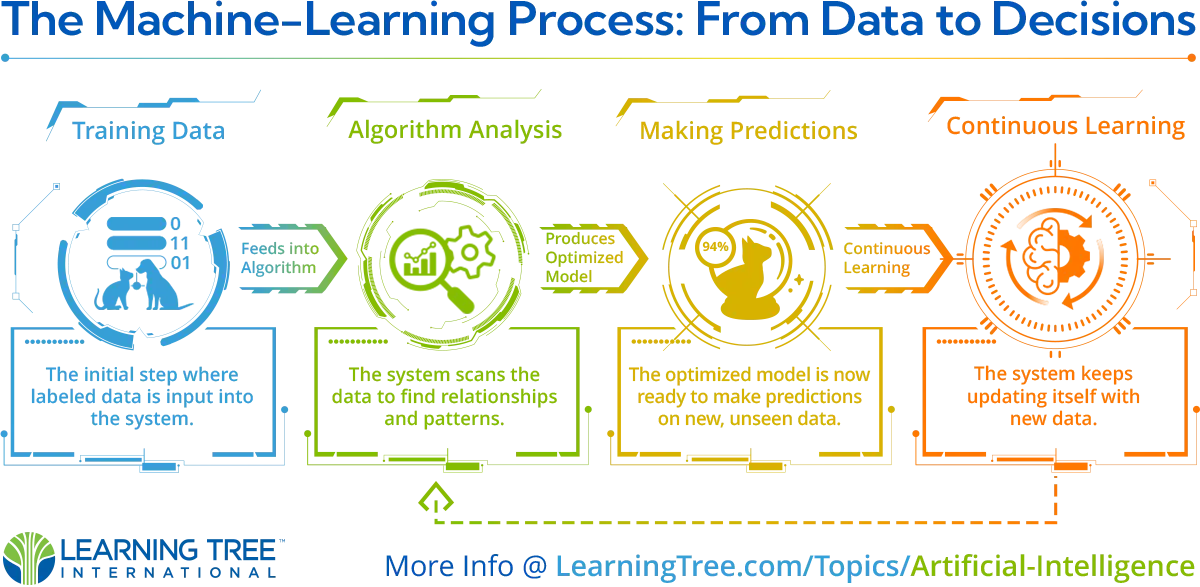
Machine learning models are trained, not explicitly coded. This training process generally follows four essential stages, which allow an AI system to adapt and evolve its capabilities.
Data Collection: The journey begins with gathering data, which may include images, text, numerical information, or videos. The quality, accuracy, and diversity of this training data directly influence future performance.
Pattern Recognition: The algorithm processes the data to identify underlying patterns, relationships, and important features.
Model Optimization: The algorithm adjusts its internal parameters through iterative testing and refinement to minimize errors and improve accuracy.
Deployment and Prediction: Once trained and optimized, the model is deployed to make predictions or decisions on new, unseen data and may continue learning from new inputs.
Types of AI: Narrow vs. General Intelligence
Artificial Intelligence is often categorized into two primary types based on its capabilities: Artificial Narrow Intelligence (ANI) and Artificial General Intelligence (AGI). This distinction separates the practical applications used today from more speculative research goals.
Artificial Narrow Intelligence (ANI): Also known as Weak AI, ANI is designed to perform a single task or a narrow range of related tasks. GPS navigation, spam filtering, and smartphone facial recognition are common examples.
Artificial General Intelligence (AGI): Also known as Strong AI, AGI refers to a hypothetical form of AI with human-like intelligence that could understand, learn, and apply knowledge across many domains. AGI remains theoretical.
Real-World Applications of AI Across Industries
AI is a present-day reality that delivers value across nearly every sector. Its ability to analyze data at scale, automate complex processes, and provide predictive insights supports innovation and efficiency.
Healthcare: Machine learning models can analyze medical images and support predictive models that help identify patients at risk, enabling proactive care and more personalized treatment plans.
For perspectives on AI in healthcare, see HBR on GenAI in Healthcare.
Cybersecurity: Machine learning systems monitor network traffic to detect anomalous patterns that may indicate a cyberattack, helping organizations respond before significant damage occurs.
Learn more in Navigating the Future of Cybersecurity and explore NIST’s AI Risk Management Framework.
Communication: Customer-service chatbots and virtual assistants rely on Natural Language Processing (NLP), a branch of AI that enables machines to understand, interpret, and generate human language.
For implementation strategies, watch Unlocking AI: Practical Strategies for Implementation and review Google’s overview of NLP.
Data Analysis: AI-powered analytics tools can sift through large volumes of data to uncover insights, trends, and predictions that support smarter business decisions.
See McKinsey’s State of AI for additional context on enterprise adoption.
Addressing the Ethical Challenges in AI Development
As AI becomes more powerful and integrated into society, its development raises important ethical questions. Fairness, transparency, and security require attention from developers, organizations, and policymakers.
For governance frameworks, consult OECD AI Principles and the European UnionU’s AI Act Explorer.
Common Ethical Concerns in AI
Inaccuracies in AI Models: An AI system learns from the data it is given. If that data reflects existing societal biases, the system may reproduce them, creating a risk of unfair outcomes.
Explore mitigation strategies in the World Economic Forum material on bias in AI.
Lack of Transparency (The “Black Box” Problem): Some advanced AI models operate in ways that are difficult to explain, which is problematic when decisions affect loans, criminal justice, or medical diagnosis.
Learn more from IBM’s Explainable AI resources.
Security and Misuse: AI capabilities can be exploited to create more sophisticated cyberattacks, disinformation, or other harmful systems, demanding robust governance and oversight.
See the NIST AI RMF Playbook.
AI Glossary: Key Terms to Know
Model Collapse: A phenomenon where model performance degrades because training increasingly relies on AI-generated data instead of original human-created data.
Model Drift: A decline in predictive accuracy that occurs when the properties of real-world data change over time.
Overfitting: A model fits its training data too closely, capturing noise instead of general patterns and performing poorly on new data.
Feature Engineering: The process of selecting, transforming, or creating input variables that help improve model performance.
Transfer Learning: A technique in which a model trained for one task is adapted to a different but related task.
The Future of Artificial Intelligence
The field of AI is evolving rapidly. Personalization and automation may create significant opportunities, but they also bring risks that require planning and active management.
Future Opportunities
Hyper-Personalization: AI may enable tailored experiences in education and healthcare, such as adaptive learning and more personalized treatment approaches.
Advanced Automation: AI-driven systems may manage complex logistics, optimize supply chains, and automate parts of scientific research.
For applied training, see AI Strategies for Project Managers.
Risks to Anticipate
Job Displacement: AI-powered automation may disrupt traditional roles, increasing the need for workforce upskilling and reskilling.
See the World Economic Forum’s Future of Jobs Report 2025 and Learning Tree’s Top AI Courses.
Ethical and Societal Dilemmas: Continued AI advancement will intensify debates around privacy, autonomy, and control, making strong governance frameworks essential.
Frequently Asked Questions (FAQs)
What is the main difference between AI and machine learning?
Artificial Intelligence is the broad scientific field focused on creating intelligent machines. Machine learning is a specific subset of AI that involves training systems to learn patterns from data without being explicitly programmed. Think of AI as the overall goal and machine learning as one of the primary methods for achieving it.
Is AI dangerous?
AI itself is a tool; its impact—positive or negative—depends on how it is designed and used. While there are valid risks related to bias, security, and job displacement, these can be managed through responsible development practices, strong ethical guidelines, and proactive regulation from governments and industry bodies.
Can I learn AI without a programming background?
Yes. While programming is a key skill for developing new AI systems, many resources and introductory courses focus on the core concepts of AI without requiring deep coding knowledge. Understanding the principles of AI, its applications, and its limitations is a valuable skill for professionals in any field, not just technology.
Begin your AI learning journey with Learning Tree’s AI Training Catalog and AI Workforce Solutions.