Article Highlights
- Only one in five organizations that adopt AI report a material impact on revenue, and just 7% of AI spend goes toward people — the gap between investment and impact is a strategy problem, not a tooling problem.
- Learning Tree's three-phase AI Adoption Framework — Align, Activate, and Demonstrate Value — turned a Northern Virginia food manufacturer's broad Claude requirement into a measurable enterprise AI adoption program.
- Role-specific training, including a customized one-day Claude Essentials experience with Claude-in-Excel exercises built on the company's own data, was delivered onsite in cohorts of 20 learners.
- Across Learning Tree's AI programs, participants have seen a 45% increase in AI confidence, tool usage rising from 48% to 100%, and 4.33 hours saved per learner each week.

Quick answer: A successful Claude deployment strategy requires more than tool access. Learning Tree's three-phase AI Adoption Framework, Align, Activate, and Demonstrate Value, helped a Northern Virginia food manufacturer turn a broad Claude requirement into role-specific training, measurable adoption, and a scalable enterprise AI program built around real workflows rather than generic courses.
Most organizations can buy AI. Few can prove it changed anything. According to McKinsey's State of AI research, only one in five organizations that adopt AI report a material impact on revenue. Deloitte's research points to a likely reason why: just 7% of AI spend goes toward people, while 93% goes toward technology. The gap between investment and impact isn't a tooling problem. It's a strategy problem, and it shows up the moment leadership asks a workforce to start using a new platform without a plan for how that adoption actually happens.
Claude is a useful lens for this problem because it's no longer a hypothetical addition to the enterprise stack. Anthropic's Opus, Sonnet, and Haiku models increasingly power the platforms leaders already use or are evaluating, from Microsoft and Google tools to GitHub, Slack, and Salesforce. That means a Claude deployment strategy isn't a future consideration for most enterprises. It's a live, current one.
This is the story of how one organization approached that question with structure instead of guesswork. A Northern Virginia food manufacturer needed to introduce Claude across management, customer service, and other functions. Rather than issue a broad mandate, the company worked with Learning Tree International, applying a three-phase AI Adoption Framework, Align, Activate, and Demonstrate Value, to convert a vague requirement into a measurable enterprise AI adoption program.
Why a broad AI mandate isn't a deployment plan
The food manufacturer's starting point will sound familiar to a lot of leaders. Claude needed to reach multiple functions, management, customer service, and beyond, but "roll out Claude" isn't an instruction anyone can execute against. It doesn't specify which roles need which skills, what success looks like, or how the organization will know if the investment worked.
Generic training programs tend to fail at this scale for a simple reason: they teach a tool in the abstract, disconnected from the actual workflows employees use every day. A standard course might explain what Claude can do in general terms, but it won't show a customer service lead how to apply it to the specific reports, spreadsheets, or communications that define their role. Without that specificity, engagement stalls, and the training becomes something employees completed rather than something they use.
This is precisely the pattern Deloitte's 7%-on-people statistic describes. Organizations spend heavily on the technology itself and treat workforce enablement as an afterthought. The food manufacturer's leadership recognized this early, which is why the engagement with Learning Tree didn't start with a training session. It started with a plan.
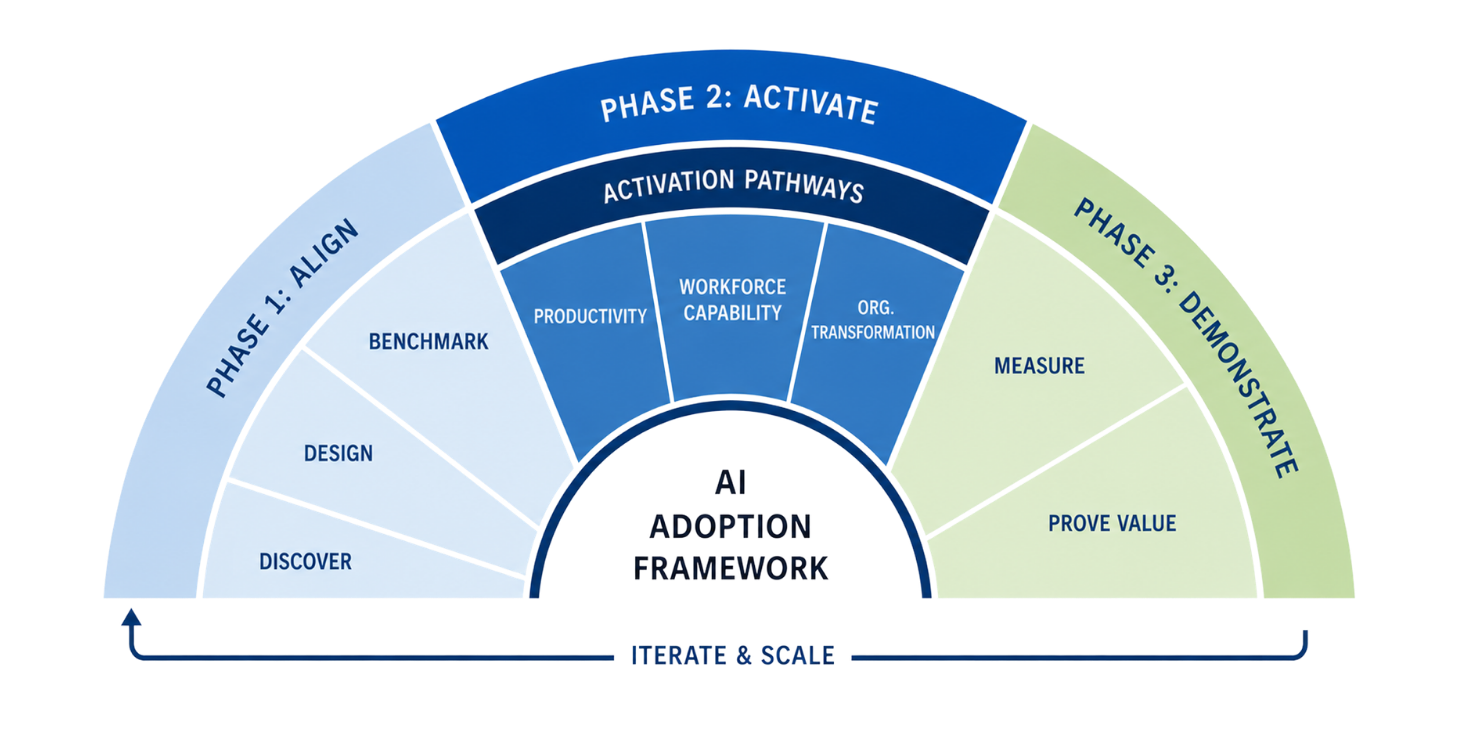
Phase 1: How does the Learning Tree AI Adoption Framework start?
The Align phase answers one guiding question: are we ready? Before a single course gets built, Learning Tree works with an organization's stakeholders to clarify priorities, so the training reflects actual business needs rather than a generic curriculum.
For the food manufacturer, this phase opened with Discover, a step where Learning Tree aligned company leaders on priority roles, business needs, licensing requirements, and the specific use cases that mattered most. This is a deceptively important step. Skip it, and a training program risks serving roles that don't need immediate support while leaving high-priority teams underserved.
From there, the Design step took over, co-building an AI adoption program around the manufacturer's actual roles and workflows instead of a one-size-fits-all template. Learning Tree also established a Benchmark, a baseline measurement of current AI knowledge and confidence across the organization. That baseline matters later. Without it, there's no reliable way to measure whether the training phase actually moved the needle.
This sequence reflects what Learning Tree calls the "Align Leaders Early" enabler: building shared understanding among leaders and stakeholders before activation begins. Organizations that skip this step often end up running training as an isolated event rather than a coordinated effort, and the difference shows up in adoption rates months later.
Phase 2: What does a real Claude deployment strategy look like?
Where Align answers "are we ready," Activate answers "are we capable?" This is the phase where planning turns into practice, and it's where the food manufacturer's Claude deployment strategy took concrete shape.
The Design output from Phase 1 became a one-day Claude Essentials experience, but with a critical distinction: the exercises were customized. Learners worked through Claude-in-Excel scenarios built around the food manufacturer's actual data and workflows, not a generic case study borrowed from an unrelated industry. This kind of contextualization is what Learning Tree's Workforce Capability Pathways are designed to deliver: role-based learning aligned to specific job responsibilities and business goals, helping employees move past basic awareness toward confident, repeatable use.
The Deliver step put this into motion through structured, onsite, instructor-led sessions organized into cohorts of 20 learners. That cohort size matters more than it might seem. Small enough to allow real interaction with an instructor, large enough to build a shared organizational fluency rather than isolated pockets of skill.
This phase illustrates Learning Tree's "Real-World Use Cases" enabler in action. Anchoring learning in a familiar tool like Excel, rather than an abstract AI interface, is what makes new skills durable. Employees don't have to translate a lesson into their actual job. The lesson is already framed around it.
Scaling Claude adoption beyond the first cohort
A single day of training, however well designed, isn't the finish line. The Scale step in Learning Tree's framework created a path to follow-on private training and ongoing coaching, ensuring the food manufacturer's first cohort became a foundation rather than an endpoint.
This matters because enterprise AI adoption tends to erode without reinforcement. A one-time session can build initial confidence, but behaviors fade if there's no structure to sustain them. Learning Tree's "Reinforce Behaviors" enabler addresses this directly, building coaching and continued practice into the adoption plan so that early gains compound instead of decaying. For the manufacturer, this created room to extend training to additional teams over time, rather than treating the initial 20-person cohort as the entirety of the initiative.
Phase 3: How do you prove a Claude deployment delivered value?
The final phase, Demonstrate Value, answers the question every executive eventually asks: is this working? This phase measures progress against the baseline established back in Phase 1, assessing post-program knowledge, confidence, tool usage, and behavior change.
Learning Tree translates these findings into what it calls an AI Impact Report, an executive-ready summary that converts adoption data into evidence of business value. While specific figures for the food manufacturer's engagement weren't disclosed, Learning Tree's broader program data offers a useful benchmark for what this phase can surface: a 45% increase in AI confidence among participants, AI tool usage climbing from 48% to 100%, and time savings of 4.33 hours per learner each week, a 10.8% productivity gain. These figures reflect general outcomes across Learning Tree's AI programs rather than manufacturer-specific results, but they illustrate the kind of measurable shift the Demonstrate Value phase is built to capture.
For the food manufacturer, the outcome wasn't just a completed training program. It was a practical, role-relevant model for enterprise AI enablement, with a clear starting point, stronger relevance to daily work, confidence among stakeholders who helped shape the solution, and a scalable structure for whatever training comes next.
To build the same foundation in your organization, start with training aligned to each phase of the framework:
What this means for organizations planning their own Claude deployment
The throughline here is straightforward: a broad Claude requirement became a structured, three-phase Claude deployment strategy, Align, Activate, Demonstrate Value, built around real roles and real workflows rather than a generic rollout.
The bigger lesson extends past Claude specifically. Whether an organization is deploying Claude, Copilot, or Gemini, adoption succeeds or stalls based on the same four enablers: aligning leaders early, grounding learning in real-world use cases, reinforcing behavior after the initial training ends, and proving impact with data rather than assumptions. The tool is rarely the deciding factor. The framework behind its adoption is.
Organizations weighing their own AI enablement path don't need to start from scratch. Book an AI Discovery Session with Learning Tree to assess readiness and map a framework suited to your organization's roles and workflows. For teams specifically evaluating Claude, Learning Tree's Claude Essentials course and the broader AI Adoption Framework offer a starting point grounded in the same approach that worked for the Northern Virginia food manufacturer.
Frequently Asked Questions (FAQs)
What is a Claude deployment strategy?
A Claude deployment strategy is a structured plan for introducing Anthropic's Claude across an organization's roles and workflows, rather than issuing a general requirement to "use Claude." Effective strategies define priority use cases, build role-specific training, and measure adoption against a baseline established before training begins.
How does the Learning Tree AI Adoption Framework work?
The Learning Tree AI Adoption Framework operates in three phases: Align, which clarifies goals and establishes a baseline, Activate, which delivers role-based training grounded in real workflows, and Demonstrate Value, which measures post-training confidence, usage, and business impact through an executive-ready AI Impact Report.
Why do generic AI training programs often fail at the enterprise level?
Generic AI training programs teach a tool in the abstract, without connecting it to the specific tasks employees handle daily. This disconnect limits engagement and retention. Role-specific training, built around an organization's actual workflows and tools, produces stronger and more durable adoption.
How long does a Claude deployment program typically take?
Timelines vary by organization, but Learning Tree's approach with the food manufacturer began with a one-day Claude Essentials training delivered to cohorts of 20 learners, followed by a scale phase offering ongoing coaching and private training. The framework supports both a quick initial rollout and long-term reinforcement.
Is this framework specific to Claude, or does it apply to other AI tools?
The framework is platform-agnostic. Learning Tree applies the same Align, Activate, Demonstrate Value structure to deployments involving Microsoft Copilot, Google Gemini, ChatGPT, and other enterprise AI tools, adapting the specific training content to the platform and the organization's workflows.
How is AI adoption success measured?
Learning Tree measures success by comparing post-training results against a baseline established during the Align phase, tracking changes in AI confidence, tool usage, and reported productivity. Results are compiled into an AI Impact Report designed to give executives clear, measurable evidence of business value.