Article Highlights:
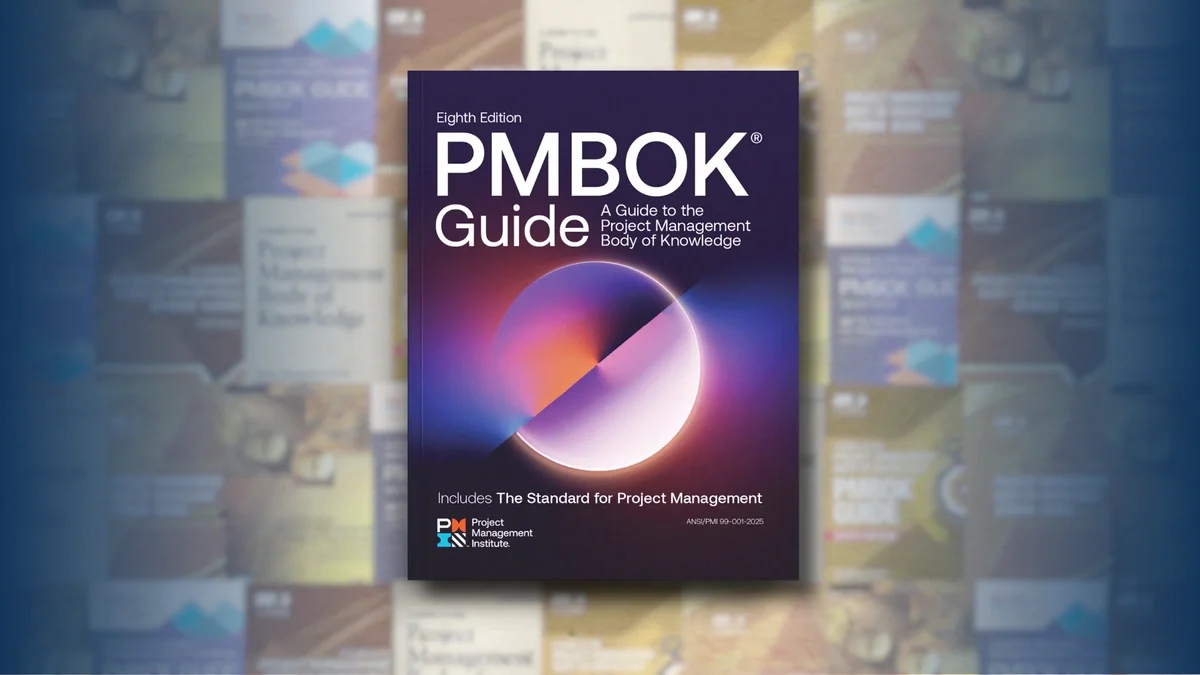
- The PMBOK® Guide – Eighth Edition is PMI®'s latest standard, released in November 2025.
- It reintroduces structure by combining six core principles and seven performance domains with five new "Focus Areas" containing 40 non-prescriptive processes.
- This update emphasizes value delivery, AI integration, and sustainability while serving as a key resource for the PMP® exam update expected in July 2026.
Navigating the New Standard
Picture this: you've spent months mastering your organization's project management approach, building confidence in your processes, only to discover that the foundational standard has shifted beneath your feet. This scenario plays out regularly in project management, where evolving methodologies reflect the changing nature of work itself.
The journey from the process-heavy Sixth Edition to the principle-based Seventh Edition left many practitioners feeling like they'd lost their compass. They had principles to guide them, but fewer concrete steps to follow when projects hit roadblocks or stakeholders demanded specific deliverables.
A Guide to the Project Management Body of Knowledge (PMBOK® Guide)—Eighth Edition emerges as a response to this challenge, bridging the gap between philosophical guidance and practical execution. It doesn't abandon the flexibility that made the Seventh Edition valuable for diverse work environments. Instead, it adds structure that practitioners and PMP certification candidates can adapt to their specific contexts.
This edition consolidates insights from more than 48,000 practitioner data points, ensuring it reflects the reality of modern project work rather than theoretical ideals. For program managers juggling cross-functional teams across different methodologies, this update provides the clarity needed to succeed in today's complex organizational environment.
What This Means for PMP Candidates
If you're preparing for the Project Management Professional (PMP)® exam, understanding how these changes affect your preparation strategy becomes essential for success. The relationship between the PMBOK Guide and the PMP exam often confuses candidates who assume the guide serves as a comprehensive exam syllabus.
The PMBOK® Guide serves as a reference, not a complete syllabus.
The PMP exam draws from the Exam Content Outline (ECO), which incorporates multiple standards and practices beyond the PMBOK Guide. While the guide remains a primary input for exam development, successful candidates study a broad range of project management practices, tools, and techniques. This approach ensures they're prepared for questions that test practical application of concepts rather than rote memorization of guide content.
- Timeline: The PMP exam update that incorporates these Eighth Edition changes is expected to launch in July 2026, giving current candidates time to complete certification under existing requirements.
- Preparation: Your exam preparation should align with the current Exam Content Outline until the official update occurs, focusing on proven study materials and practice exams.
Strategy: Treat the PMBOK® Guide – Eighth Edition as a tool to deepen your understanding of modern project management practices rather than a textbook to memorize for exam success.
The Return of Structure: 5 Focus Areas
The most significant operational shift in the Eighth Edition comes through the introduction of five "Focus Areas." These areas directly address feedback that the previous edition lacked specific guidance for moving projects from concept to completion. Think of a project manager who needs to explain their approach to a skeptical executive or train a new team member on project fundamentals. The previous edition's principles provided excellent philosophical grounding but left gaps in practical application.
These Focus Areas act as a bridge between high-level principles and day-to-day execution, containing 40 adaptable processes that teams can customize to their needs. Consider how these areas might work in practice: an agile development team uses the same Focus Areas as a construction project, but their implementation looks completely different. The agile team might create user story maps during Planning, while the construction team develops detailed architectural specifications.
- Initiating: Validates business value and authorizes work to begin. Agile teams might create a compelling vision statement and product roadmap here, while traditional teams build a comprehensive project charter with detailed business case justification.
- Planning: Defines the scope, objectives, and path forward for successful delivery. This includes iterative planning cycles for hybrid environments and detailed scheduling with critical path analysis for predictive approaches.
- Executing: Coordinates people and resources to create deliverables that meet quality standards. The focus here centers on maintaining team collaboration, ensuring quality gates are met, and sustaining momentum through inevitable challenges.
- Monitoring and Controlling: Tracks performance against plans and initiates corrective changes when needed. This area ensures data-driven decisions maintain project health and stakeholder confidence throughout the project lifecycle.
- Closing: Formally wraps up project activities and transfers deliverables to operational teams. It ensures the organization captures lessons learned and celebrates achievements while preparing for future initiatives.
6 Core Principles of Project Management
The foundation of the new guide rests on six core principles that consolidate the 12 principles found in the Seventh Edition. These aren't rigid rules to follow blindly, but rather behavioral guideposts that influence effective leadership across different organizational contexts. Imagine a program manager overseeing teams that span different departments, methodologies, and even time zones. These principles provide a common language that helps align diverse groups under a shared philosophy of success.
The consolidation from 12 to 6 principles reflects feedback that practitioners needed fewer, more memorable concepts they could internalize and apply consistently. Each principle represents years of collective wisdom from project management communities worldwide. They guide decision-making when project managers face competing priorities or unclear stakeholder expectations.
- Adopt a holistic view: See the project as part of a larger organizational system, understanding how decisions impact other initiatives and business objectives.
- Focus on value: Prioritize outcomes that matter to stakeholders over outputs that simply check boxes on project plans.
- Embed quality: Build quality considerations into processes and deliverables from the very beginning rather than inspecting it in at the end.
- Lead accountably: Take ownership of decisions and outcomes while fostering a culture of responsibility throughout the project team.
- Integrate sustainability: Consider the long-term environmental and social impact of project work, ensuring decisions support organizational values and community wellbeing.
- Build empowered teams: Create environments where teams can self-organize, make decisions, and thrive without constant micromanagement.
7 Performance Domains
While principles guide behavior and thinking, performance domains define what project managers actually do on a day-to-day basis. The Eighth Edition refines the previous model into seven performance domains that represent the key areas where project managers must demonstrate capability. Think of these domains as the essential aspects of project health that require constant attention and management.
This structure simplifies the previous model to make the domains more actionable for practitioners. Instead of memorizing complex input-output relationships, project managers focus on maintaining the health of these seven interconnected areas. When one domain suffers, it typically impacts others, creating a cascade effect that skilled project managers learn to recognize and address proactively.
- Governance: Establishing the rules, frameworks, and decision-making processes that guide project execution and ensure alignment with organizational objectives.
- Scope: Defining and managing what needs to be delivered, including the boundaries of what's included and excluded from project work.
- Schedule: Managing timelines, dependencies, and resource allocation to deliver results when stakeholders need them most effectively.
- Finance: Overseeing budget management, cost control, and value realization to ensure projects deliver return on investment expectations.
- Stakeholders: Engaging the people who impact or are impacted by the project, maintaining relationships that support project success throughout its lifecycle.
- Resources: Managing the team members, physical assets, and tools needed to complete project work efficiently and effectively.
- Risk: Identifying potential threats and opportunities, then navigating uncertainty with strategies that protect project objectives while enabling innovation.
New Critical Topics: AI, PMOs, and Procurement
The Eighth Edition expands into areas that reflect the evolving landscape of modern project management. These additions aren't theoretical exercises but practical responses to challenges that project managers face in contemporary organizations. The guide recognizes that ignoring these topics would leave practitioners unprepared for the realities of their work environment.
Artificial Intelligence (AI)
You can't discuss modern project management without addressing artificial intelligence and its growing role in project execution. The new guide moves beyond the hype to focus on practical applications that deliver measurable value. This might involve using AI for predictive risk analysis, automated scheduling optimization, or resource modeling that adapts to changing project conditions. For large organizations, integrating AI tools into project workflows becomes a necessity for maintaining competitive speed and accuracy in decision-making.
Project Management Offices (PMOs)
The role of the PMO continues to evolve from compliance enforcement to value creation, and the Eighth Edition reflects this transformation. Traditional PMOs often functioned as gatekeepers, ensuring projects followed standardized processes regardless of context. Modern PMOs support teams by facilitating knowledge sharing, providing coaching and mentorship, and driving strategic alignment between project work and organizational objectives. The guide offers practical guidance on how PMOs can adapt their services to support diverse project approaches while maintaining organizational coherence.
Procurement
Procurement receives a fresh treatment with reintroduced process guidance that reflects modern contracting realities. However, the guide presents procurement in a non-prescriptive way that allows adaptation to specific project needs and organizational contexts. This flexibility becomes crucial when dealing with agile contracts that require iterative scope definition, traditional fixed-price agreements with detailed specifications, or hybrid approaches that combine elements of both contracting models.
Why This Matters for Your Organization
Adopting the mindset of the PMBOK 8th Edition can drive tangible benefits for your organization:
- Improved Strategic Alignment: By focusing on value, projects are more likely to support organizational goals.
- Enhanced Agility: The flexible, principle-based approach allows teams to pivot quickly in response to change.
- Better Cross-Team Collaboration: Common principles provide a shared language for diverse teams, reducing friction and dependencies.
- Higher Stakeholder Satisfaction: A strong focus on the stakeholder performance domain ensures that needs are met and expectations are managed.
Conclusion
The PMBOK® Guide – Eighth Edition is a welcome update for professionals navigating the complexities of modern project delivery. It simplifies the framework, integrates emerging technologies, and keeps the focus squarely on value.
For program managers in large enterprises, it provides a practical playbook for alignment and execution. It moves us away from "checking the box" and toward "delivering the value."
Ready to align your team with the latest standards? Start by reviewing our official PMI training courses and assessing where your current projects stand. The shift to value delivery starts with you.
Frequently Asked Questions
When will the PMBOK Guide 8th Edition be released?
A: PMI released the PMBOK® Guide – Eighth Edition November 2025, representing their latest thinking on project management standards and practices.
Will the PMP exam change immediately when the 8th Edition is released?
A: No, the PMP exam typically updates several months after a new guide publication to allow for proper integration and candidate preparation. The exam update aligning with the Eighth Edition is expected to launch on July 1, 2026.
How does the 8th Edition differ from the 7th Edition?
A: The Eighth Edition reintroduces practical structure by adding five "Focus Areas" containing 40 processes to complement the principles-based approach of the Seventh Edition. It also consolidates the 12 principles into six core principles and refines the performance domains from eight to seven for improved clarity.
Do I need to buy the 8th Edition if I am taking the exam in early 2026?
A: If you plan to take the exam before July 1, 2026, the current exam version applies and you should focus on current study materials. However, the Eighth Edition provides valuable context on emerging practices like AI integration and sustainability considerations that can strengthen your overall project management knowledge and professional development.